Tariffs and Trade: The Potential Impact on the Economy

During his first administration, President Donald Trump made tariffs and trade a major part of his economic policy. As he campaigned for another term, he further emphasized how he would use tariffs and trade if reelected. His strategy of issuing tariffs would be used to create more manufacturing jobs for Americans, shrink both the federal deficit and the U.S. trade deficit, and lower food prices.1 During the campaign, then-Vice President Kamala Harris pushed back, saying that Trump’s strategy would have a negative impact on families and their income. She saw, for example, a 20 percent universal tariff by a Trump administration costing families nearly $4,000 per year.2 This debate came at a time when inflation and the cost of consumer goods were among the top issues on voters’ minds.

What Are Tariffs?

Tariffs are charged as a percentage of the price a buyer pays a foreign seller for a product or commodities. Tariffs are intended to protect and boost domestic industries and home-grown manufacturers when the price of imports increase. Or, they can be used to punish foreign countries for committing unfair trade practices.3

So, why does President Trump advocate for tariffs today? He has cited several reasons, including generating revenue for the United States; influencing the policies of, and wielding power over, rival countries; and evening out the balance between U.S. imports and exports. Earlier this year, the Commerce Department reported that the U.S. goods trade deficit in 2024 had reached a record $1.2 trillion. In other words, the United States imported $1.2 trillion more in goods than it exported. The report also showed that the United States ran record bilateral trade deficits with Mexico, Vietnam, India, Taiwan, South Korea, and the European Union (EU).

According to White House Senior Counselor for Trade and Manufacturing Peter Navarro, a central goal of President Trump’s trade policy is to reduce the trade deficit “to zero.” This month, Navarro blamed high levels of imports for millions of lost American jobs, thousands of factory closings, and social and health problems such as alcoholism and drug addiction.4

A Study on the Impact of Tariffs
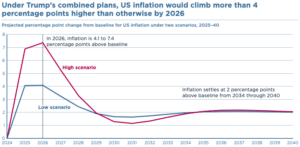
Last year, a study by the Peterson Institute for International Economics (PIIE) examined the impact of now-President Trump’s proposed tariffs.5 The major takeaways: lower national income, lower employment, and higher inflation. According to the study, the manufacturing and agriculture sectors would be most impacted.

Per PIIE: “We have no partisan goal in publishing this research. Our concerns are about the policies, not the candidate. Our objective is to educate policymakers and the public about the effects these measures would have on the U.S. and other economies.”6

PIIE predicted a 10 percent policy on all U.S. tariffs would increase inflation by 1.3 percent, and a 60 percent policy on imports from China would increase inflation by 0.7 percent.7

The Historical Context of Tariffs

From 1790 to 1860, approximately 90 percent of federal revenue came from tariffs.8 A federal income tax was created in 1913 to help generate revenue, and in 1945 the dependency on and use of tariffs decreased due to the need for larger revenue streams that tariffs alone couldn’t provide.9 The Trade Act of 1974 changed how presidents approached trade and tariffs with other countries for over 40 years, until President Trump.10 The law preauthorized removal of trade barriers on a reciprocal basis in negotiations with foreign countries, later renewed by subsequent administrations. Freer trade became a key part of Republican Party platforms for presidential candidates throughout this time period.

The State of Tariffs Today

In 2018, President Trump issued tariffs on steel and aluminum that caused the European Union to put tariffs on American whiskey, leading to exports of whiskey falling by 30 percent after a 25 percent tariff was issued.11 Those tariffs are set to expire in 2025. President Trump’s tariffs on China led to soybean exports dropping by 75 percent.12 He has proposed using tariffs on farm imports to lower the cost of food products, but some economists feel this would increase grocery prices and reduce consumer choice.13 These economists warn that foreign producers can pass along some or all of the tax burden on consumers in the form of higher prices.14 When the last fiscal year ended on September 30, tariffs and fees generated roughly one-third of the revenue of income taxes and roughly half of the revenue of Social Security and Medicare taxes.15

Now in the early days of his second term, President Trump has carried out his promise of 25 percent tariffs on goods from Canada and Mexico and 10 percent on goods from China. The Canada and Mexico tariffs have been paused for 30 days. The tariffs from China could impact over $450 billion worth of imports, and the Tax Foundation estimates they could add a $172 tax burden per household.16 China has responded with 15 percent tariffs on coal, natural gas, crude oil, and farm equipment. Tariffs on Canada and Mexico would impact produce such as tomatoes, strawberries, and avocados, as well as car and gas prices and construction materials like lumber.17 PIIE predicts that the combined tariffs would cost the median household over $1,200 a year.18 President Trump has also issued a 25 percent tariff on all steel and aluminum imports, which would impact Canada and Mexico the most.

Discussion Questions

  1. Should the United States increase tariffs on other countries to address economic concerns like inflation and the loss of U.S. jobs?
  2. How, if at all, might tariffs impact industries in your state and community?
  3. Should Congress have more authority to set tariff policies? Or do you think tariffs are an appropriate use of executive power?
  4. Which should be a greater priority when seeking to boost the economy: issuing tariffs or creating stronger trade agreements? Why?

As always, we encourage you to join the discussion with your comments or questions below.

Close Up is proud to be the nation’s leading nonprofit civic education organization, working with schools and districts across the country since 1971. If you would like to partner with us or learn more about our experiential learning programs, professional development, or curriculum design and consulting, contact us today! 


Sources

[1] Economic Times: economictimes.indiatimes.com/news/international/world-news/us-election-2024-how-trumps-trade-war-could affect-everyday-americans-and-their-businesses
[2] PBS: https://www.pbs.org/newshour/economy/trump-favors-huge-new-tariffs-how-do-they-work
[3] PBS: https://www.pbs.org/newshour/economy/trump-favors-huge-new-tariffs-how-do-they-work
[4] Politico: https://www.politico.com/news/2025/02/05/trump-trade-deficit-2024-00202569
[5] PIIE: https://www.piie.com/blogs/realtime-economics/2024/how-much-would-trumps-plans-deportations-tariffs-and-fed-damage-us
[6] PIIE: https://www.piie.com/blogs/realtime-economics/2024/how-much-would-trumps-plans-deportations-tariffs-and-fed-damage-us
[7] PIIE: https://www.piie.com/blogs/realtime-economics/2024/how-much-would-trumps-plans-deportations-tariffs-and-fed-damage-us
[8] PBS: https://www.pbs.org/newshour/economy/trump-favors-huge-new-tariffs-how-do-they-work
[9] PBS: https://www.pbs.org/newshour/economy/trump-favors-huge-new-tariffs-how-do-they-work
[10] PIIE: https://www.piie.com/blogs/realtime-economics/2024/trumps-selective-celebration-president-mckinley
[11] Economic Times: economictimes.indiatimes.com/news/international/world-news/us-election-2024-how-trumps-trade-war-could affect-everyday-americans-and-their-businesses
[12] Economic Times: economictimes.indiatimes.com/news/international/world-news/us-election-2024-how-trumps-trade-war-could affect-everyday-americans-and-their-businesses
[13] Economic Times: economictimes.indiatimes.com/news/international/world-news/us-election-2024-how-trumps-trade-war-could affect-everyday-americans-and-their-businesses
[14] ABC News: https://abcnews.go.com/Business/harris-trump-debate-economists-assess-attacks-inflation-tariffs/story?id=113584629
[15] PBS: https://www.pbs.org/newshour/economy/trump-favors-huge-new-tariffs-how-do-they-work
[16] NPR: https://www.npr.org/2025/02/05/nx-s1-5284991/trump-tariffs-higher-prices-inflation-mexico-canada-china
[17] NPR: https://www.npr.org/2025/02/05/nx-s1-5284991/trump-tariffs-higher-prices-inflation-mexico-canada-china
[18] PIIE: https://www.piie.com/research/piie-charts/2025/trumps-tariffs-canada-mexico-and-china-would-cost-typical-us-household
 

Lina Khan, the FTC, and Antitrust Laws

Over the past four years, policy put forth by President Joe Biden’s administration represented a notable shift in the executive branch’s attitude toward multi-conglomerate merging. This merging refers to large corporations buying up smaller businesses from a variety of different industries, thus reducing the possibility of competition from small business.

During the Biden administration, the Federal Trade Commission (FTC) adopted an agenda of general deterrence on corporations that own too large a percentage of a given industry, often referred to as a monopoly, filing multiple high-profile antitrust lawsuits that drew national attention to then-FTC Chair Lina Khan. Khan’s lawsuits contradicted the deregulation agenda that began with President Ronald Reagan’s administration and was maintained by every president until Biden. President Biden justified the shift, stating, “We’re now 40 years into the experiment of letting giant corporations accumulate more and more power. And what have we gotten from it? Less growth, weakened investment, fewer small businesses. Too many Americans who feel left behind. Too many people who are poorer than their parents.”1  

Khan was vocal about her belief that a major cause of inflation is corporate consolidation, or the merging of smaller businesses into monopolies. She noted that “even as some of the supply chain issues have eased, prices have not come down concurrently as much,” and implied that the manufactured inflation by large corporations was good for their profits.2 While there is no exact boundary within a given market that labels a corporation a monopoly, Khan stated that the FTC could look at the behavior of a corporation and see if it is operating with a “too big to care” approach, signaling they have too much power. This is where the Biden administration’s FTC would take antitrust action, using laws and regulations designed to prevent companies from forming monopolies or engaging in practices that unfairly restrict competition in the marketplace.3 The most recent attempt by the FTC to address such behavior was the proposed Kroger-Albertsons grocery merger, blocked in two different courts as of December 2024. The potential remains for the merger to move forward in President Donald Trump’s administration, which would result in the largest single grocery corporation in U.S. history.4  

Khan pointed to the pharmaceutical industry, tech companies, and the hospitality industry as illustrative examples of how unchecked monopolies can drive up costs for Americans. For instance, the FTC claimed that the pharmaceutical company Teva filed improper patents on prescriptions like inhalers to prevent generic options from being made. It found that the same inhaler that costs $7 in France costs American consumers $500, as Americans are forced to buy the brand name.5 The FTC announced a bipartisan rule in December 2024 banning junk fees for concert tickets and hotel stays, stating, “People deserve to know up front what they are being asked to pay.”6 The FTC also announced that it would look into large artificial intelligence companies that it claimed are given undue influence on markets and are engaging in collusion or price-fixing at casinos and hotels by providing the same algorithms to entire industries that use them to set their prices.7  

President Biden largely stood by the decisions of the FTC, though he declined to renominate Khan to another seven-year term as commissioner. Khan, who stepped down in 2025, garnered mixed reactions from both Republicans and Democrats. Notably, Vice President JD Vance has shown some support, stating that he doesn’t “agree with Lina Khan about everything, but (he) think(s) she’s been smart about going after these big tech companies.”8 

The courts, however, do not always agree. The FTC lost high-profile cases, including antitrust suits it filed against tech companies Meta in 2020 and Microsoft in 2022. Startup founders have complained that that these lawsuits are scaring off investors so much that it’s stifling innovation. Some say the Biden administration’s FTC exercised too much power and are preparing to take action in district courts and, political experts suspect, in the Supreme Court.9 

President Trump, meanwhile, designated Andrew Ferguson as the new chair of the FTC on his first day in office. The future of antitrust policies and laws under his leadership remains a significant area of public and political debate.

Discussion Questions 

  1. Should the Trump administration’s FTC continue the trend of antitrust policies? What might be some benefits and drawbacks of this approach?  
  2. Should there be a legally defined percentage of a given market that one corporation is allowed to have influence or ownership over? How might that affect American consumers? 
  3. How do issues like prescription costs, junk fees, or AI impact your community? Do you think the actions taken by Khan and the FTC will change how they impact you? If so, how? 
  4. How much control should the federal government have in limiting the power of monopolies? How might more control protect or harm consumers? 

As always, we encourage you to join the discussion with your comments or questions below.

Close Up is proud to be the nation’s leading nonprofit civic education organization, working with schools and districts across the country since 1971. If you would like to partner with us or learn more about our experiential learning programs, professional development, or curriculum design and consulting, contact us today! 


Sources

[1] The White House: https://www.whitehouse.gov/briefing-room/speeches-remarks/2021/07/09/remarks-by-president-biden-at-signing-of-an-executive-order-promoting-competition-in-the-american-economy/ 
[2] “60 Minutes”: https://www.youtube.com/watch?v=ebQtWZH3TW4 
[3] Department of Justice: https://www.justice.gov/atr/antitrust-laws-and-you  
[4] National Public Radio: https://www.npr.org/2024/12/10/nx-s1-5114999/kroger-albertsons-merger-ftc-lawsuit-court-ruling 
[5] Federal Trade Commission: https://www.ftc.gov/news-events/news/press-releases/2024/03/ftc-files-amicus-brief-asthma-inhaler-patent-dispute 
[6] Federal Trade Commission: https://www.ftc.gov/news-events/news/press-releases/2024/12/federal-trade-commission-announces-bipartisan-rule-banning-junk-ticket-hotel-fees 
[7] Bloomberg Law: https://news.bloomberglaw.com/us-law-week/antitrust-risks-to-firms-lurk-inside-some-ai-pricing-algorithms 
[8] CNBC: https://www.youtube.com/watch?v=w7MA2EkpRXM 
[9] “60 Minutes”: https://www.youtube.com/watch?v=ebQtWZH3TW4 


The Second Trump Presidency 


Donald Trump was inaugurated as the 47th president of the United States on January 20, 2025. In his first day in office, President Trump signed 26 executive orders, the most in recent history. In contrast, President Joe Biden signed nine on his first day in office and President Trump signed just one when he was inaugurated in 2017. Now, the nation is reflecting on his inaugural address and the executive orders he has already signed and is looking to President Trump’s second “first 100 days” in office.

What Did Trump Say in His Inaugural Address?

George Washington began the tradition of giving a speech upon being inaugurated, and every president since has given one. Most inaugural addresses are meant to unify the country after the campaign, reaffirm their commitment to national values such as democracy and liberty, and set forth the president’s overarching political principles. Historians and pundits say President Trump’s second inaugural address was unusual in that he laid out specific policy actions he wanted to take, from renaming Denali to Mt. McKinley to declaring the country would recognize only two genders.

While President Trump began his speech by characterizing himself as a peacemaker and a unifier, pledging to create a golden age for the country, it quickly became partisan. He mentioned the increase in his support by Hispanic and Black voters, the “radical and corrupt establishment,” and that he felt the Department of Justice had been weaponized against him. He also spoke extensively on his immigration and energy policy goals, including one of his campaign catchphrases, “Drill, baby, drill.”

Many presidents since the end of World War II have talked broadly about world peace. President Trump spoke generally about ending conflicts and having the wisdom to avoid new wars. However, he also referenced Manifest Destiny, the 19th century philosophy that the United States was divinely destined to expand its borders, which was used to justify the displacement and extermination of millions of Native Americans. He complained about Panama’s administration of the Panama Canal and declared the Gulf of Mexico will now be known as the Gulf of America.

Why Do We Keep Track of the President’s First 100 Days?

Since Franklin Delano Roosevelt’s first presidency in 1933, the country has kept track of a president’s first 100 days in office. In his first 100 days, President Roosevelt passed regulations and pushed legislation through Congress to help the country recover from the Great Depression. Ever since, presidents have been evaluated on the success of their first 100 days. The actions of a president at the start of their term can let the country know what to expect.

What Can We Expect from Trump’s First 100 Days?

Before taking office, President-elect Trump messaged that his goal for his first 100 days was to reverse President Biden’s policies and pick up where he left off in 2020. We can expect major changes to our diversity, environmental, immigration, and foreign policies.

President Trump signed an executive order declaring that there are only two genders, and that the United States would not recognize transgender people. He also ended diversity, equity, and inclusion hiring goals for the federal government. President Trump has already withdrawn the United States from the Paris climate agreement and declared an energy emergency to promote drilling on federal lands. He signed an expected, but controversial, executive order to pardon the nearly 1,500 January 6 rioters, including hundreds convicted of assaulting police, carrying firearms, and destroying property.

We can also expect lawsuits challenging many of these executive orders. The American Civil Liberties Union has already pledged to challenge President Trump’s executive order to end birthright citizenship for people whose parents are not in the country legally. The state attorney general of California is expected to file suits against President Trump’s pledge for mass deportations of undocumented immigrants.

Discussion Questions

  1. Did you watch the inaugural address? What do you think about President Trump’s vision for America’s future?
  2. What are your views on the president’s executive orders? Which do you agree with? Which do you disagree with?
  3. What do you want to see in the new administration’s first 100 days in power?
  4. What message would you want to send to President Trump as he begins his second term?
  5. Why do you think it’s important for the new administration to listen to young people?

Additional Links 

  • WATCH President Trump’s inaugural address on C-SPAN.
  • WATCH conservative and liberal responses to President Trump’s inaugural address:
  • REVIEW President Trump’s America First priorities.
  • READ the list of presidential actions.

Related Posts

As always, we encourage you to join the discussion with your comments or questions below.

Close Up is proud to be the nation’s leading nonprofit civic education organization, working with schools and districts across the country since 1971. If you would like to partner with us or learn more about our experiential learning programsprofessional development, or curriculum design and consultingcontact us today! 


Sources

https://www.brookings.edu/articles/the-first-100-days-when-did-we-start-caring-about-them-and-why-do-they-matter/
https://www.npr.org/2024/11/06/nx-s1-5181800/2024-election-trump-first-100-days-agenda
https://www.si.edu/stories/brief-history-presidential-inaugural-speeches
https://www.usnews.com/news/national-news/articles/2024-12-09/4-day-one-promises-from-president-elect-donald-trump
https://www.nytimes.com/interactive/2025/01/20/us/trump-inauguration-speech-annotated.html
https://apnews.com/article/donald-trump-inauguration-swearing-capitol-b3549ebe5dae74a872502aa79def7a11
https://thehill.com/regulation/court-battles/5097337-aclu-sues-trump-order/
https://www.cbsnews.com/sacramento/news/trump-inauguration-california-lawsuits-executive-orders/


The Decline of Local Newspapers

A free press is a crucial part of our democracy—so important that it was enshrined in the First Amendment of the Constitution. Once a staple of information, newspapers have been steadily declining and disappearing for decades. There are nearly 6,000 newspapers that publish in the United States and, on average, two shut down every week.1 Current projections show that by the end of this year, the United States will have lost one-third of the newspapers that it had back in 2005.2 What does a community lose when its newspaper folds?

The decline of local newspapers can be attributed to several factors, including high production costs, decreased advertising revenue, and declining readership. These compounding factors can lead newspapers to lay off employees or cut back on how frequently they print as cost-cutting measures. Newspapers that once published daily may now print only a few editions per week. Some have shifted to become online-only publications. Other have shuttered altogether. Newspapers have become increasingly reliant on digital advertising to cover their operational costs, with digital ad sales accounting for nearly half of all revenue they take in.3

A shift to consuming news online, intensified by smartphones, has disrupted traditional news outlets like print media. In a 2023 survey by the Pew Research Center, only nine percent of U.S. adults said they turn to print publications often to get their news, compared to 56 percent who said they get their news digitally.4 The survey also found that nearly one-third of all young Americans get most of their news online from TikTok.5

The Local News Initiative, a project from Northwestern University that tracks local news outlets across the United States, has found that over 1,500 counties have only one local news outlet. More than 200 counties have none at all.6 This lack of local news outlets creates “information deserts” that deprive communities of vital information. Typically, when a newspaper shutters, there are no other news outlets—in print or online—that fill the information gap.7 Rural and low-income communities are more likely to suffer from a lack of quality news.8

“Increasingly, I’m worried that we’re evolving into a nation of journalistic haves and have-nots,” said Penny Abernathy of the Local News Initiative. “That has huge implications for not only our democracy, but for our society.”9 Journalists serve as checks on power, bringing accountability and transparency by investigating and reporting on government officials, school board members, and business owners. Their stories spur local governments to act on issues that they may not otherwise address. By reporting the facts, whether good or bad, they strengthen their community’s faith in local leaders and institutions. But in the last two decades, two-thirds of local reporters have lost their jobs.10 This creates a void of in-depth coverage and quality reporting on relevant topics and pressing issues.

The reasons for the decline of newspapers also impact our democracy by enabling “more corruption and irresponsible spending” by local governments and “more straight ticket voting, less competitive elections, and lower turnout” by voters.11 Newspapers keep people informed about the issues their community faces and how their local government functions. They provide updates about upcoming elections, candidates, city ordinances, policing procedures, and educational decisions. When people are aware of what’s going on, they can feel more invested in the success of their community and be more likely to civically engage in it. Conversely, people are less likely to speak out against a policy if they are unaware that it’s being considered by their city council, and they may decide to not vote in a local election if they don’t know about the candidates’ backgrounds or platforms.

The local angle of a story—the voices, opinions, and needs that are important to distinct communities—are lost when news is only available online or through national sources. These types of news can create media echo chambers and increase political partisanship, as they tend to frame stories, for a larger audience, in terms of “this side verses that side.”12 By highlighting conflict, it becomes difficult to see people, even neighbors, as anything other than the political party they belong to or the candidates they vote for. Online sources are also more susceptible to misinformation and disinformation without the journalistic standards practiced by newspaper journalists, editors, and publishers.

The sense of community that comes from knowing local news—even weekly football scores, marriage announcements, and obituaries—creates a common connection that can’t be easily replicated online or on a national level. “Our paper spoiled us,” said Steve Rader, who lives outside a small, rural community in Texas that lost its newspaper last year. “They did so much work. And it was so colorful and beautiful, and they celebrated our successes and our tough times.”13 When asked if the loss of the newspaper felt personal, he replied, “Oh, yes, yes. Yes, that paper was a part of our life.”14

Discussion Questions

  1. Does your community have a newspaper? (You can find out by exploring the Local News Landscape map from the Local News Initiative.) If so, do you or members of your family regularly read it?
  2. What sources do you get your news from?
  3. What are some benefits of having access to the news online? What are some drawbacks?
  4. Why are local newspapers important to communities?
  5. What do you think should be done to support newspapers and local journalism?

Other Resources

As always, we encourage you to join the discussion with your comments or questions below.

Close Up is proud to be the nation’s leading nonprofit civic education organization, working with schools and districts across the country since 1971. If you would like to partner with us or learn more about our experiential learning programs, professional development, or curriculum design and consulting, contact us today! 


Sources

[1] Axios: https://www.axios.com/2023/11/16/newspapers-decline-hedge-funds-research
[2] Ibid.
[3] Pew Research Center: https://www.pewresearch.org/journalism/fact-sheet/newspapers/
[4] Pew Research Center: https://www.pewresearch.org/journalism/fact-sheet/news-platform-fact-sheet/
[5] Pew Research Center: https://www.pewresearch.org/short-reads/2023/11/15/more-americans-are-getting-news-on-tiktok-bucking-the-trend-seen-on-most-other-social-media-sites/
[6] Local News Initiative: https://localnewsinitiative.northwestern.edu/projects/state-of-local-news/explore/#/localnewslandscape
[7] Local News Initiative: https://news.northwestern.edu/stories/2022/06/newspapers-close-decline-in-local-journalism/
[8] Local News Initiative: https://localnews.knilab.com/projects/state-of-local-news/2023/report/#ethnic-communities
[9] PBS: https://www.pbs.org/newshour/show/the-connections-between-decline-of-local-news-and-growing-political-division
[10] Local News Initiative: https://localnews.knilab.com/projects/state-of-local-news/2023/report/#ethnic-communities
[11] PBS: https://www.pbs.org/newshour/show/how-the-loss-of-local-newspapers-fueled-political-divisions-in-the-u-s
[12] Ibid.
[13] Ibid.
[14] Ibid.


Teaching with Disciplined Nonpartisanship

This workshop will equip educators with the skills to facilitate discussions around controversial issues while maintaining a neutral position. Teachers will explore strategies to expose students to a diversity of perspectives, cultivating in students a willingness to listen deeply and patiently and engage regularly with arguments with which they disagree, ensuring unbiased teaching throughout the process.


Why Voting Matters: How Laws and Systems Shape Our Elections and Affect Voters

The Importance of Our Right to Vote

The 2020 election marked the highest voter turnout of the 21st century at 67 percent—the highest since 1900. In a country with a rich history of struggle and sacrifice for the right to vote, why do so many Americans remain disengaged?

Despite the monumental battles for voting rights, including movements for women’s suffrage and civil rights, many people still do not vote. With the 2024 election on the horizon, we will examine one factor that impacts voter turnout: the systems and laws that shape how we vote. From local and state races to the presidential election, voting laws play a critical role in who votes and how their voices are heard. We will also look at some of the less-examined issues connected to this year’s election.

Local and State Elections

Often when citizens think about voting, they’re thinking about the presidential election. However, state and local elections can have far greater effects on our lives. Questions such as public transit funding, the minimum wage, and recycling regulations are decided by state and local elections and officials.

This November, Americans across 41 states will be voting on some 160 statewide ballot measures, including measures covering the controversial question of abortion. The 2022 Supreme Court decision in Dobbs v. Jackson Women’s Health Organization overturned the landmark Roe v. Wade (1973), putting the issue of abortion and any right to privacy between a woman and her health care provider back into the hands of the states. Because of this, voters in 11 states will be telling their state government whether or not it should protect a right to an abortion. Other ballot measures voters will see in November include those regarding citizenship, electoral systems, criminal justice, policing, taxes, wages, and drug policy.

READ more about this year’s ballot measures across the country.

READ more about Dobbs v. Jackson Women’s Health Organization.

Differences Among Voting Laws

In the United States, there isn’t a federal standard when it comes to voting procedures. Instead, it is the responsibility of the states to create their own. This leads to a plethora of differences in how states run their elections.

To better understand this, let’s look more closely at voter registration laws, voter ID laws, and ranked-choice voting. States such as Pennsylvania, Louisiana, and Arizona have a strict deadline for voters to register. Other states like Virginia, Wyoming, and California don’t have a deadline and voters can register at the polling center on Election Day. When it comes to voting in person, whether early or on Election Day, 15 states do not require a voter to present a valid form of ID to vote. The states that do require voter ID differ in whether or not a valid ID must contain a photo. Other states require signature verification; if the voter signature provided doesn’t match the one on file, that vote will not be counted.

READ more about voter ID laws in different states.

How many candidates someone can vote for also differs from state to state because of a newer process in the United States known as ranked-choice voting. Ranked-choice voting allows voters to rank the candidates rather than choose just one; in the event a voter’s first choice doesn’t receive many votes, their vote then goes to their second and/or third choice. States such as Maine and Alaska have recently implemented this process in statewide elections. Some states, like Colorado and Maryland, use ranked-choice voting in local elections but others, such as Florida and Kentucky, have banned the process entirely. Although ranked-choice voting is new to the United States, countries such as Australia, Malta, and Ireland have used ranked-choice voting for over 100 years and a dozen others implemented the system prior to the United States.

WATCH to learn about the process, pros, and cons of ranked-choice voting.

Differences in How Elections Are Decided

Congressional and gubernatorial elections are decided by a popular vote, but the presidential election is decided by the Electoral College. Some Americans support this system of electing the president, which is outlined in the Constitution. Others believe it is outdated or misrepresentative of the electorate’s intent.

Under the Electoral College system, a candidate must win majority support in states across the country—in smaller, more rural states as well as in larger, more populated states. Supporters say this process ensures that a presidential candidate has broad appeal and that voters in rural areas are not ignored in favor of those in dense population centers. Detractors, however, say the system doesn’t always match the results of the nationwide popular vote and gives outsized importance to voters in “battleground” or “swing” states that could conceivably go for either candidate. This year, for example, voters in battleground states such as Pennsylvania and Georgia could be instrumental in deciding the next president.

The Electoral College system has its merits and drawbacks. But a voter’s perception of their own importance can affect their feelings about casting a ballot. However, it is still incredibly important for all of us as Americans to vote to choose our elected officials and weigh in on statewide ballot measures. This is exactly why voting matters—because the leaders and policies chosen at the ballot box shape our society in ways that affect us all.

Don’t Sit Out

As we approach the 2024 election, the differences in how our voting systems operate across states—from registration laws to voter ID requirements—can feel overwhelming at times. However, it’s vital to remember that every election, from the local to the national level, carries significant weight. While the Electoral College system may not always reflect the popular vote, each ballot cast plays a role in shaping policy and electing leaders who impact everything from education to health care to civil rights. In a democracy, voting is both a right and a responsibility. Understanding the systems that influence our elections can empower us to make informed choices and ensure our voices are heard where it counts.

Discussion Questions

  1. What would you say to someone who is considering not voting in this election?
  2. Which level of government do you think has the most impact on your day-to-day life? Why?
  3. If you had to choose, which of the following do you believe is the most important reason to vote?
    1. To fulfill your civic duty
    2. To weigh in on laws and ballot measures
    3. To have a say in local and state elections
    4. To have a say in federal (presidential and congressional) elections
  4. Is our voting system set up to best represent the will of the people? What reforms, if any, would you make to our system of elections?
  5. Are voting laws and processes best handled by the states or should there be some federal standards? Explain your reasoning.

As always, we encourage you to join the discussion with your comments or questions below. Close Up is proud to be the nation’s leading nonprofit civic education organization, working with schools and districts across the country since 1971. If you would like to partner with us or learn more about our experiential learning programs, professional development, or curriculum design and consulting, contact us today! 

Young Americans’ Views of the Presidential Election

In this final post of a three-part series, we continue exploring the results of the “Reimagining Political Leadership: The Outlook of Young Americans” survey focused on the political attitudes of Americans aged 18-34. The survey was designed by the Sine Institute of Policy and Politics at American University in partnership with Future Caucus and the Close Up Foundation, and based on interviews conducted by the Generation Lab, a data intelligence company that gathers and interprets the views and behavior of young adults. In this post, we examine the views of young Americans as they relate to the 2024 presidential election.

READ: All About the Survey

The survey’s key findings relating to the 2024 election and the presidential candidates include the following:
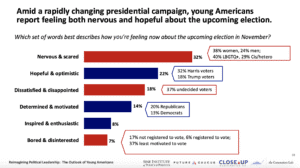
  • Only about half (49 percent) of young Americans describe themselves as very likely or certain to vote (eight or higher on a ten-point scale).
  • The most common descriptors of their mood heading into November are “nervous and scared” followed by “hopeful and optimistic.”
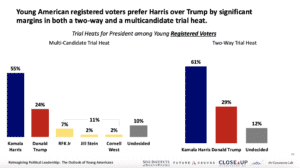
  • Vice President Kamala Harris has a large, double-digit lead over former President Donald Trump in both the multi-candidate and head-to-head trial heat. Vice President Harris’ advantage with young Americans is rooted in substantive evaluations; she is viewed as better than former President Trump on all eight qualities that we tested.
  • Young Americans have a broad and substantive voting agenda, but it tracks all Americans in centering primarily around the economy and the cost of living.
  • While voting is only one of many behaviors that young Americans see as critical to a maintaining a functioning democracy, emphasizing the importance of making their voices count and having a say in their future are most persuasive.

The findings also show that young Americans have more negative emotional responses to the election, with half of respondents saying that they are feeling either “nervous and scared” or “dissatisfied and disappointed.” These responses can be partially explained by the findings that majorities of young Americans agree with statements such as:
  • There often are not candidates running who I am excited to support (72 percent agree).
  • It’s hard to get information that is trustworthy and reliable about the candidates and their issue positions (69 percent agree).
  • It’s hard to get information that is relevant to me about the candidates’ positions on issues I care about (57 percent agree).

Finally, the poll found that young people support Vice President Harris by a 2-to-1 margin over former President Trump in a head-to-head poll.

Discussion Questions

  1. How do the views reflected here compare with your views?
  2. If you had to choose one word to reflect how you are feeling about the upcoming election, what would it be?
  3. If you were able to survey young Americans, what would you want to know?

Previous Posts About the Survey Data

As always, we encourage you to join the discussion with your comments or questions below.

Close Up is proud to be the nation’s leading nonprofit civic education organization, working with schools and districts across the country since 1971. If you would like to partner with us or learn more about our experiential learning programs, professional development, or curriculum design and consulting, contact us today! 


Sources

Featured Image Credit: Saul Loeb/AFP via Getty Images


State and Federal Legislation on Gender-Affirming Care for Minors

In the past six years, the introduction of bills in state legislatures to ban gender-affirming care for transgender and gender diverse youth has increased exponentially. In 2018, two such bills were introduced. In 2023, there were 185. Arkansas became the first state to ban gender-affirming care for youth in 2021; now, there are 26 states with bans on gender-affirming care for transgender youth. In response, other states have begun passing laws protecting access to gender-affirming care. It is estimated that 110,000 transgender teenagers, about 40 percent of transgender youth, live in states with bans on gender-affirming care.

What is Gender-Affirming Care?

Gender-affirming care consists of an array of services, including both medical and non-medical interventions for transgender and gender diverse people. Medical services can include hormone therapy, surgery, and mental health services. Non-medical services can include adopting gender-affirming hairstyles, clothing, names, gender pronouns, and restrooms and other facilities.1

Gender-affirming medical care for youth most often consists of puberty blockers that stop the onset of puberty. Doctors say the goal of puberty blockers is to give young people time to mature enough mentally and emotionally to make informed decisions about whether to pursue permanent treatment. Once someone stops taking them, puberty starts again as normal. Gender-affirming medical care for youth can also include hormone therapy and, rarely, surgical intervention.2

What Kinds of Bills Have Passed?

The details of state bans on gender-affirming care vary, but in general, the laws prevent transgender minors from accessing puberty blockers, hormones, and surgery. More than 20 states have passed laws that punish health care professionals for providing gender-affirming care to their minor patients. Five states have made it a felony, and in eight states it is illegal for providers to offer minors referrals for care outside their state or otherwise aid and abet access to gender-affirming care.3

Sixteen states and the District of Columbia have shield laws that protect access to gender-affirming care for transgender and gender diverse youth. Shield laws vary by state but generally preserve minors’ access to gender-affirming care and protect patients, guardians, and medical professionals from prosecution for seeking or providing care.4

What Do Opponents of Gender-Affirming Care for Minors Say?

Opponents of providing gender-affirming care point to examples of people who began their transition and later expressed regret or decided to de-transition later in life. They argue that minors are not mature enough to make such life-altering decisions.

“We need to just pause, we need to understand what these emerging therapies actually may potentially do to our kids. My heart goes out to them. … This is an extremely uncomfortable position for me to be in. I don’t like it. But I have to do what I believe right now is in the best interest of the kids,” said Iowa Gov. Kim Reynolds when signing the state’s ban on gender-affirming care for minors.5

Opponents also point to increasing restrictions abroad. The National Health Service in England recently ended the practice of prescribing puberty blockers to children, citing a lack of evidence of the safety and effectiveness to make them a part of routine treatment.6 Many other European countries do not allow the use of cross-sex hormones until age 16, and only then allow them after a patient has completed several psychotherapy sessions. In addition, most European countries ban gender-affirming surgery until age 16.7

What Do Supporters of Gender-Affirming Care for Minors Say?

Nearly all major U.S. medical associations support youth access to gender-affirming care, including the American Medical Association, the American Academy of Pediatrics, and the American Psychological Association. In particular, these groups point to evidence demonstrating that medically necessary gender-affirming care enhances mental health outcomes for transgender youth, including by reducing suicidal ideation.8

The AMA released this statement after Arkansas passed its ban: “Decisions about medical care belong within the sanctity of the patient-physician relationship. … We believe it is inappropriate and harmful for any state to legislatively dictate that certain transition-related services are never appropriate and limit the range of options physicians and families may consider when making decisions for pediatric patients.”9

Supporters also argue that transgender and nonbinary minors are not the only youth seeking gender-affirming care. A Harvard T.H. Chan School of Public Health study examined 2019 data for 22,827,194 youth with health insurance. It found that most gender-affirming surgeries for both transgender and cisgender (someone whose gender identity matches their sex at birth) youth were chest-related surgeries, and 97% of breast reduction surgeries were for cisgender males. Breast augmentation surgery for cisgender females is likewise considered gender-affirming medical care.10 Supporters point to this data and note that the same surgeries that are being banned for transgender and gender diverse youth are relatively unregulated for their cisgender counterparts.

Are There Any Federal Bills in Congress?

Like in state legislatures, there have been bills introduced in Washington, D.C., that would ban gender-affirming care for youth and others that would protect it. Rep. Marjorie Taylor Green (R-Ga.) introduced H.R.1399, the Protecting Children’s Innocence Act, which would make it a felony to perform any gender-affirming care on a transgender minor, prohibit the use of federal funds for gender-affirming care or for health insurance that covers such care, and prohibit universities from offering instruction in gender-affirming care.11 Sen. Ed Markey (D-Mass.) introduced S.2246, the Gender-Affirming Care Access Research for Equity (CARE) Act, which would provide $25 million in funding for the National Institutes of Health and the Centers for Disease Control and Prevention to research barriers to gender-affirming care and the impact of those barriers on the health of transgender teens.12

Discussion Questions

  1. Do you think gender-affirming care should be banned until an individual turns 18?
  2. Does your state have laws about gender-affirming care? If so, do you agree or disagree with those laws? Why?
  3. Should more temporary medical interventions, like puberty blockers, be treated differently than more permanent treatments, like hormone therapy or surgery?
  4. What authority, if any, should the government have over medical care decisions for citizens?

Additional Resources

Related Blog Posts

As always, we encourage you to join the discussion with your comments or questions below.

Close Up is proud to be the nation’s leading nonprofit civic education organization, working with schools and districts across the country since 1971. If you would like to partner with us or learn more about our experiential learning programs, professional development, or curriculum design and consulting, contact us today! 


Sources

[1] Office of Population Affairs: https://opa.hhs.gov/sites/default/files/2022-03/gender-affirming-care-young-people-march-2022.pdf
[2] CNN: https://www.cnn.com/2024/03/15/health/puberty-blockers-explained-nhs-wellness/index.html#:~:text=%E2%80%9CThe%20use%20of%20puberty%20blockers,started%2C%20bone%20mineralization%20normalizes.%E2%80%9D
[3]  Association of Medical Colleges, https://www.aamc.org/news/states-are-banning-gender-affirming-care-minors-what-does-mean-patients-and-providers; NPR: https://www.npr.org/sections/shots-health-news/2024/07/03/nx-s1-4986385/trans-kids-health-bans-gender-affirming-care
[4] UCLA Law: https://law.ucla.edu/academics/centers/center-reproductive-health-law-and-policy/shield-laws-reproductive-and-gender-affirming-health-care-state-law-guide#:~:text=Currently%2C%20through%20legislation%20or%20executive,to%20gender%2Daffirming%20health%20care.
[5] Des Moines Register: https://www.desmoinesregister.com/story/news/politics/2023/03/21/kim-reynolds-says-iowa-should-pause-gender-affirming-care-to-trans-kids/70034427007/
[6] The Guardian: https://www.theguardian.com/society/2024/mar/12/children-to-stop-getting-puberty-blockers-at-gender-identity-clinics-says-nhs-england
[7] Forbes: https://www.forbes.com/sites/joshuacohen/2023/06/06/increasing-number-of-european-nations-adopt-a-more-cautious-approach-to-gender-affirming-care-among-minors/
[8] Endocrine Society: https://www.endocrine.org/news-and-advocacy/news-room/2023/ama-gender-affirming-care
[9] American Medical Association: https://www.ama-assn.org/press-center/press-releases/ama-states-stop-interfering-health-care-transgender-children
[10] JAMA Network Open: https://jamanetwork.com/journals/jamanetworkopen/fullarticle/2820437
[11] H.R. 1399 Protecting Children’s Innocence Act: https://www.congress.gov/bill/118th-congress/house-bill/1399
[12] Gender-Affirming Care Access Research for Equity Act: https://www.congress.gov/bill/118th-congress/senate-bill/2246?q=%7B%22search%22%3A%22care+act+gender%22%7D&s=1&r=1


What Young Americans Seek in Political Leaders

On September 17, the Sine Institute of Policy and Politics at American University released results of a poll that focused on the views of Americans ages 18-34. The survey was designed by the Sine Institute in partnership with Future Caucus and Close Up Foundation and was based on interviews conducted by Generation Lab, a data intelligence company that gathers and interprets the views and behavior of young adults. Last week, we explored young Americans’ levels of optimism and hope. In this post, we will explore the question of what young Americans are looking for in their political leaders.

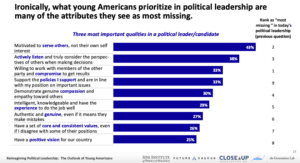
When poll participants were asked to list the three most important qualities they look for in a political candidate, they listed a motivation to serve others as the highest priority. They also said they want leaders who actively listen to and consider the perspectives of others and who are willing to compromise to get results. Interestingly, they ranked all three of those attributes above the priority of a leader supporting the policies that the poll participants support.
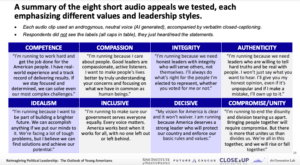
One element of this survey that distinguishes it from many other political surveys is that it asked respondents to listen to eight short, AI-generated audio clips of a hypothetical candidate’s pitch to voters. The text of those clips, along with their labels, is shared below. Survey respondents did not see the labels.

  • Competence: “I’m running to work hard and get the job done for the American people. I have real-world experience and a track record of delivering results. If we stay focused and determined, we can solve even our most complex challenges.”
  • Compassion: “I’m running because I care about people. Good leaders are compassionate, active listeners. I want to make people’s lives better by truly understanding your concerns and focusing on what we have in common as human beings.”
  • Integrity: “I’m running because we need honest leaders with integrity who will serve others, not themselves. I’ll always do what’s right for the people I’m elected to represent, whether you voted for me or not.”
  • Authenticity: “I’m running because we need leaders who are willing to tell hard truths and be real with people. I won’t just say what you want to hear. I’ll give you my honest opinion, even if it’s unpopular, and if I make a mistake I’ll own up to it.”
  • Idealism: “I’m running because I want to be part of building a brighter future. We can accomplish anything if we put our minds to it. We’re facing a lot of tough problems, but I believe we can find solutions and achieve our potential.”
  • Inclusive: “I’m running to make sure our government serves everyone equally. Every voice matters. America works best when it works for all, with no one left out or left behind.”
  • Decisive: “My vision for America is clear and it won’t waiver. I am running because America deserves a strong leader who will protect our country and enforce our basic rules and values.”
  • Compromise/Unity: “I’m running to end the disunity and division tearing us apart. Bringing people together will require compromise. But there is more that unites us than divides us. We’re all in this together, and we will rise or fall together.”

Respondents were asked to rate, on a scale of 1-10, how appealing they found each campaign pitch.

Next week, we will take a final look at the results from this Sine Institute survey of young Americans to explore their views about the 2024 presidential election.

Discussion Questions

  1. Which of the eight excerpts above (competence, compassion, integrity, etc.) speak most directly to you? Least directly? Why?
  2. What is something that a political candidate could say that would help them appeal to you? Are you looking for the same things in political leaders as the people who responded to this survey?
  3. In your own words, how would you describe what you are looking for in a candidate for the presidency?

Related Blog Posts

As always, we encourage you to join the discussion with your comments or questions below.

Close Up is proud to be the nation’s leading nonprofit civic education organization, working with schools and districts across the country since 1971. If you would like to partner with us or learn more about our experiential learning programs, professional development, or curriculum design and consulting, contact us today! 


Sources

Featured Image Credit: Sine Institute of Policy & Politics


Young Americans’ Views on U.S. Democracy

On September 17, the Sine Institute of Policy and Politics at American University released results of a poll that focused on the views on Democracy of Americans ages 18-34. The survey was designed by the Sine Institute in partnership with Future Caucus and Close Up Foundation and was based on interviews conducted by the Generation Lab, a data intelligence company that gathers and interprets the views and behavior of young adults. While the poll does focus on the 2024 election, it also explores broader themes about how young Americans are viewing, and making sense of, U.S. democracy. 

SEE: Full Results of the Poll 

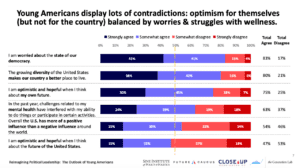
As the data shows, young Americans are worried about democracy in the U.S. and are not optimistic or hopeful when they think about the future of the United States. However, they are optimistic and hopeful when they think about their own futures.  

Elsewhere in the poll results, young Americans give the government poor grades (out of a 4.0 scale) when it comes to: 

  • providing an opportunity for an affordable, quality college education to those who want it (1.72). 
  • having an economy where people can work and afford to take care of their basic needs (1.62). 
  • having an effective government that represents the interests of all Americans (1.61). 
  • having capable and trustworthy political leaders (1.47).

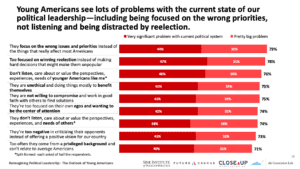
As the data indicates, young Americans think that political leaders do not pay enough attention to the priorities of average people, that they are too focused on winning reelection, and that they are unethical. They also indicated a desire for more compromise and a willingness to work in good faith to find solutions. 

In next week’s blog post, we will explore what young people say they are looking for in political leaders. 

Discussion Questions 

  1. When you think about the future of the United States, are you more optimistic or pessimistic? Explain your reasoning.
  2. How closely do your views about political leaders match the views of people who were included in this poll?
  3. What do you prioritize in a political candidate?

Related Blog Posts

As always, we encourage you to join the discussion with your comments or questions below.

Close Up is proud to be the nation’s leading nonprofit civic education organization, working with schools and districts across the country since 1971. If you would like to partner with us or learn more about our experiential learning programs, professional development, or curriculum design and consulting, contact us today! 


Sources

Featured Image Credit: Sine Institute of Policy & Politics