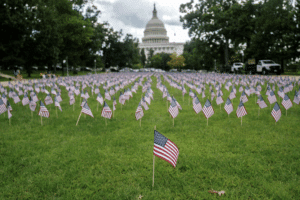
 The murder of conservative political activist Charlie Kirk on September 10 was another act of political violence at a time when political violence seems to be on the rise in the United States.1 A poll released in July 2025 found that three-quarters of Americans view political violence as a serious threat, with the number reaching almost 90% among Democratic voters and almost 60% among Republican voters.2 And, according to polling from YouGov, “Most Americans across the political spectrum say political violence is never justified, but younger and more liberal Americans are more likely to disagree.”3
In addition to the assassination of Kirk, a series of other high-profile acts of political violence have stirred the public consciousness about this issue. There were two assassination attempts against now-President Donald Trump in 2024, including one at a rally in Butler, Pennsylvania, in which a bullet struck Trump’s ear and one audience member was killed. Earlier this year, Melissa Hortman, a state Democratic lawmaker in Minnesota, was killed along with her husband, and another Democratic official, John Hoffman, was attacked along with his wife. In April, a California man pleaded guilty to attempting to assassinate Supreme Court Justice Brett Kavanaugh at his home in Maryland. The same month, Pennsylvania Gov. Josh Shapiro (D) and his family had their home set ablaze by an arsonist. On January 6, 2021, a violent mob stormed the Capitol and threatened to attack members of Congress and to hang then-Vice President Mike Pence in order to stop the certification of the 2020 election results.4 In addition to these high-profile cases, Reuters has identified at least 300 acts of politically motivated violence since 20215 and argues that the United States is experiencing the most political violence since the 1960s and 1970s.6
The story of how we got here is too long, too complicated, and—at the moment—too hard to state clearly for this post to explore. But we know that a mixture of partisan media, vitriolic political campaigns, and algorithms on social media that stoke our anger and fear all play leading roles. And, just as there is no one path that led us here, it is unlikely that there is a single path that will lead us from this low point in U.S. political culture. But schools can and must play a role in shaping a future in which basic tenets of free speech, free thought, and democracy are valued and protected.
Rachel Kleinfeld, a senior fellow at the Carnegie Endowment for International Peace, says, “Most partisans hold major misbeliefs about the other party’s preferences that lead them to think there is far less shared policy belief. This perception gap is highest among progressive activists, followed closely by extreme conservatives: in other words, the people who are most involved in civic and political life hold the least accurate views of the other side’s beliefs.”7
This is so, at least in part, because people tend not to talk about political and social issues outside of their immediate networks or their online bubbles, leaving significant room for mischaracterization and misunderstanding. Schools can help students and families confront this challenge in many ways. A few ideas that teachers and school leaders should consider include:
- Holding regular dialogues and deliberations about challenging political and social issues. By engaging in deliberation, students have shown an increased mutual respect across ideological lines, with 89% of participants at 2024’s America in One Room: The Youth Vote agreeing with the following statement after deliberation: “I learned a lot about people very different from me—about what they and their lives are like.”8
- Hosting panels or speaker series on contemporary issues to expose students to different perspectives on those issues.
- Embedding media literacy and, especially, social media literacy in as many courses and areas of curriculum as possible.
- Embedding democratic practices such as participatory budgeting and meaningful student government in the school culture and calendar.
- Finding opportunities for students in different schools and different parts of the political spectrum to interact routinely, in person or virtually.
- Including requirements for exploring an ideologically diverse range of sources in any inquiry projects in humanities classes.
This is, of course, only a partial list. And all of us in education recognize that most of these steps do not come without costs. There may be public pushback for speakers and panels or holding dialogues about certain topics, there are always budgetary constraints when it comes to participatory budgeting and student government, and curricular time is precious. However, we all must do what we can to confront political violence from whatever position in the world we hold. And educators hold a position that could allow for the shaping of a new, better political culture.
As always, we encourage you to join the discussion with your comments or questions below.
Sources
Featured Image: REUTERS/Jim Urquhart
[1] Brookings Institution: https://www.brookings.edu/articles/political-violence-in-the-us/
[2] National Public Radio: https://www.npr.org/2025/07/01/nx-s1-5452527/poll-democracy-trump-immigration
[3] YouGov: https://today.yougov.com/politics/articles/52960-charlie-kirk-americans-political-violence-poll
[4] PBS News: https://www.pbs.org/newshour/politics/how-recent-political-violence-in-the-u-s-fits-into-a-long-dark-history
[5] Reuters: https://www.reuters.com/world/us/new-cases-political-violence-roil-us-ahead-contentious-election-2024-10-21/
[6] Reuters: https://www.reuters.com/investigates/special-report/usa-politics-violence/
[7] Carnegie Endowment for International Peace: https://carnegieendowment.org/research/2023/09/polarization-democracy-and-political-violence-in-the-united-states-what-the-research-says?lang=en
[8] Close Up Foundation and Stanford University Deliberative Democracy Lab: https://www.closeup.org/a1r-deliberation-results/