The United States and Iran: How Did We Get Here?
April 17, 2026 by
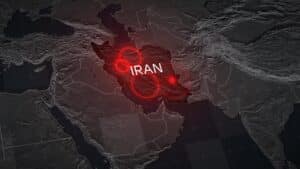 The conflict between the United States and Iran has deep roots. When the U.S. military struck three nuclear facilities in Iran on June 22, 2025, President Donald Trump declared that the goal of disabling the sites had been achieved, though intelligence sources remained uncertain as to the extent of the damage.1 For some Americans, the strikes seemed to come out of nowhere. But the context extends back to the 1950s at least, making it difficult to understand this newest chapter of U.S.-Iran conflict without first understanding what came before.
Oil, a Coup, and the Cold War
In 1951, Iranian Prime Minister Mohammad Mossadegh expelled English oil manufacturers from Iran and nationalized Iran’s oil industry, arguing that England was exploiting Iran’s resources without fair compensation. England responded by embargoing Iranian oil, which hurt Iran’s economy badly. Resultant political unrest in Iran, paired with the country’s massive oil resources, made President Dwight Eisenhower concerned that Iran would become a powerful ally of the Soviet Union in the Cold War, and that other countries could follow. In 1953, the Central Intelligence Agency supported a coup in Iran that overthrew Mossadegh. As intended, political power was handed to Iran’s shah, who had previously been a monarchic figurehead without much power.
The shah allied Iran solidly with the United States. President Eisenhower announced his “Atoms for Peace” program in 1953, in which the United States provided nuclear reactors, enriched uranium (or fuel for the reactors), other necessary technology and equipment, and training expertise to countries that promised to use the material only for non-military purposes (mostly energy) and to allow inspections to verify this. The shah requested to participate, and Iran’s first nuclear reactor began operation in 1967. Both the reactor and its fuel were American in origin.
Revolution and Rupture
However, political unrest returned to Iran. The shah banned political opposition, censored the press, and relied on secret police to violently silence dissidents. Unemployment, corruption, and inequality convinced many Iranians that the shah only cared about elites, and some blamed America for handing power to the shah in the first place. Strikes and protests swept the country. Religious clergy joined the movement, arguing that the shah’s secularism had damaged the country. The 1979 Iranian Revolution ended Iran’s monarchy and handed power to Ayatollah Ruhollah Khomeini, one of the religious clerics, who declared Iran an Islamic republic and cut diplomatic ties with America. The Revolutionary Guards—then an informal religious militia formed by Khomeini—repressed other political groups who were not under the control of the ruling clerical organizations loyal to Khomeini, and the violence often exceeded what took place under the shah.2
Angry that the United States sheltered the shah, the Iranians took 66 Americans hostage in what had been the U.S. embassy in Tehran, holding 52 of them for 444 days. Iran’s Atoms for Peace program was terminated, and Iran’s secret police no longer fed intelligence to the United States. By 1984, the U.S. State Department had designated Iran as a state sponsor of terrorism for its role in supporting terrorist attacks on Americans, including Hezbollah’s 1983 bombing of a U.S. Marine compound in Beirut that killed 241 U.S. military personnel. Iran continues to hold that designation today for its longstanding support of Hezbollah, Hamas, the Houthis in Yemen, and militia groups in Iraq and Syria.3 In a March 2026 statement, the Trump White House declared, “More Americans have been killed by Iran than any other terrorist regime on Earth.”4
At the same time, throughout the 1980s, Iran kept its nuclear development secret from the United States but continued to fuel nuclear reactors with help from Russia, China, Pakistan, and North Korea; the Iranians also built additional nuclear facilities in the 1990s. Thus, there is significant distrust of Iran when it claims that its nuclear development is peaceful, intended to be used solely for energy and research.
Sanctions, Stuxnet, and the Nuclear Deal
After 2002, when U.S. intelligence discovered two of Iran’s clandestine nuclear facilities, President George W. Bush intensified economic sanctions on Iran, which slowed but did not stop Iran’s nuclear program. The relationship between the United States and Iran worsened significantly during President Barack Obama’s administration in 2010, when a cyberattack was conducted on an Iranian nuclear facility; a virus called “Stuxnet,” likely deployed by the United States and Israel in partnership, caused many Iranian nuclear machines to self-destruct—the first known digital weapon used to disrupt a nuclear facility.5
President Obama teamed up with five other major countries to negotiate with Iranian leaders, resulting in 2015’s Joint Comprehensive Plan of Action (JCPOA), which sought to limit Iran’s nuclear production and required Iran to submit to inspections from an international agency—both attempts to ensure that nuclear facilities in Iran would only produce energy, not weapons. In exchange, many sanctions on Iran were lifted.
The Deal Collapses
In his first term, President Trump withdrew from the JCPOA, arguing that it was a “one-sided deal.” He called provisions of the agreement which allowed Iran to resume its nuclear enrichment program when the agreement phased out by 2030 “totally unacceptable,” arguing that such provisions would spark a nuclear arms race in the Middle East. He also criticized the agreement’s inspection provisions as inadequate and its failure to prevent Iran from building ballistic missiles capable of delivering a nuclear warhead.6
When President Trump reimposed sanctions, Iran stopped following the plan as well, producing past set limits and reducing the frequency of inspections. By 2025, Iran had enriched enough uranium for an estimated four to five nuclear warheads. On June 15, 2025, Israel conducted air strikes in Iran, weakening Iran’s air defenses. President Trump viewed this as an opportunity to strike Iranian nuclear facilities to prevent Iran from becoming a nuclear threat.7 The United States struck one week later.
What Happened Next
In December 2025, Iran was gripped by widespread protests against economic turmoil and the longstanding repression of the governing regime. The regime responded by cutting nearly all internet access and killing thousands of civilians.8 Shortly after, the armed conflict between the United States and Iran escalated dramatically. A broader military campaign began in late February 2026, with more than 50,000 U.S. service members deployed to the region and the Strait of Hormuz—through which 20% of the world’s oil flows—effectively shut down.9 The war’s human and economic costs sparked a debate in Congress over whether to cut off funding for a military operation that lawmakers never voted to authorize. That debate is the subject of a separate Close Up post: Should Congress Prohibit Federal Funding for the War in Iran?
Discussion Questions
- The United States helped overthrow Iran’s government in 1953 and then provided Iran with nuclear technology through the Atoms for Peace program. How do these early decisions continue to shape the U.S.-Iran relationship today?
- Iran says its nuclear program is for energy and research, not weapons. The United States and Israel have used sanctions, cyberattacks, and military strikes to limit it. When, if ever, is it justified for one country to use force to prevent another from developing nuclear capabilities?
- The JCPOA used diplomacy to try to limit Iran’s nuclear program; President Trump withdrew from it and later used military strikes. What are the advantages and disadvantages of diplomatic agreements versus military action as tools of foreign policy?
- If military intervention is being considered, are cyberattacks like Stuxnet a better or worse alternative to conventional strikes? Explain your reasoning.
- After reading this backgrounder, what questions do you still have about the U.S.-Iran relationship that would help you evaluate the current debate over the war?
As always, we encourage you to join the discussion with your comments or questions below.
Close Up is proud to be the nation’s leading nonprofit civic education organization, working with schools and districts across the country since 1971. If you would like to partner with us or learn more about our experiential learning programs, professional development, or curriculum design and consulting, contact us today!
Sources
Image Credit: Shutterstock/artemegorovv
[1] Washington Post: https://www.washingtonpost.com/national-security/2025/06/24/us-iran-bomb-assessment-nuclear-sites-not-destroyed/
[2] Britannica: https://www.britannica.com/event/Iranian-Revolution/Aftermath
[3] U.S. State Department: https://www.state.gov/reports/country-reports-on-terrorism-2023/
[4] The White House: https://www.whitehouse.gov/releases/2026/03/the-iranian-regimes-decades-of-terrorism-against-american-citizens/
[5] New York Times: https://www.nytimes.com/2012/06/01/world/middleeast/obama-ordered-wave-of-cyberattacks-against-iran.html
[6] National Public Radio: https://www.npr.org/2018/05/08/609383603/trump-u-s-will-withdraw-from-iran-nuclear-deal
[7] National Public Radio: https://www.npr.org/2025/06/21/nx-s1-5441127/iran-us-strike-nuclear-trump
[8] Amnesty International: https://www.amnesty.org/en/latest/campaigns/2026/01/what-happened-at-the-protests-in-iran/
[9] CBS News: https://www.cbsnews.com/news/u-s-launches-strikes-iranian-nuclear-facilities-trump-says/